By: Francesca Mundrick, Founder & Executive Director
The normative modern environmental movement, starting in the 1960s, is slowly becoming irrelevant and in desperate need of reform. The inception of environmentalism was necessary and created great progress- environmental education is at a height, environmental protections abound, and awareness is ever present. However, where there are positives, exist negatives.
Environmentalism has moved away from many of its original premises and goals. Environmentalism has become highly polarized and weaponized for political and economic gain. Environmentalism has become globalist, elitist, and pretentious. Environmentalism leans on collectivist policies that centralize governmental power directly conflicting with American ideals of constitutional libertarianism. Environmentalism does not target the root causes of the very issues it attempts to solve. All of these factors have caused the environmental movement to become stagnant, lacking vision, and devoid of continued growth.
We first must realize that our relationship with the environment is sociological not ecological. It is cultural not scientific. Understanding the systems of our world and facing the realities of those systems is how we overcome them.
We are ready for the truth, however, we cannot seem to see the reality right in front of us. We the people are already in a revolution against the powerful who seek ultimate control. How can we deny that we are in a revolution when it is no secret that warfare on knowledge, localism, spirituality, and land has persisted in our society over decades. In order to win this revolution, like any real meaningful challenge, we must awaken, we must resist, and we must take steps towards change. This will require dedication and discomfort. In a time where globalization, corporatization, urbanization, and technological advancement abound, we must fight for our sovereignty.
What is sovereignty? To be sovereign is to be free. Sovereignty is to be independent of control and influence in daily life. Sovereignty is to have liberty, agency, and autonomy.
So, what do we do to get sovereignty back?
We rewild. Rewilding is not a fad, a cause, a greenwashing ploy, another band aid on environmental problems-it is the transformation of our society in real time. Rewilding is slowly being moved from its niche social space into mainstream culture as it is the only true vision for the future.
Rewilding as a discipline includes several branches- Conservation, Human, and Community Rewilding. The philosophical foundation of rewilding, however, is what makes it groundbreaking for modern time. Rewilding is hope. Rewilding is authentic in a fake inauthentic world. Rewilding connects us to our Universe, Earth, and human spirit. It is the recognition that nature, including our human nature, is the only thing that is real, the only thing that we can trust, and where our real power lies.
Conservation Rewilding is an approach that prioritizes nature-first, nature-led ecological restoration strategies. Conservation Rewilding drives balance by maximizing the functionality of ecosystems through restoration practices that focus on coexistence, ecological relationships, habitat connectivity, increasing biodiversity and, overall, low management strategies. While historically associated with megafauna reintroduction, wilderness conservation, and the Three Cs Model (Cores, Corridors, and Carnivores), Conservation Rewilding in practice is now seen as any benefit to nature regardless of scale.
Human Rewilding is an approach that reconnects people to the knowledge provided by the innate wildness of our primitive human origins. Human Rewilding is defined by the practice of reskilling which promotes wellbeing, resilience, and self-sufficiency in the post-industrial modern world. Reskilling activities include foraging, herbalism, homesteading, hunting, fishing, ancestral knowledge, weaving, permaculture, holistic wellness, composting, beekeeping, textile making, astronomy, wilderness survival, primitive lifeways, orienteering, bushcraft, and more. Human Rewilding is a rediscovery of self, nature connectedness, and the human spirit.
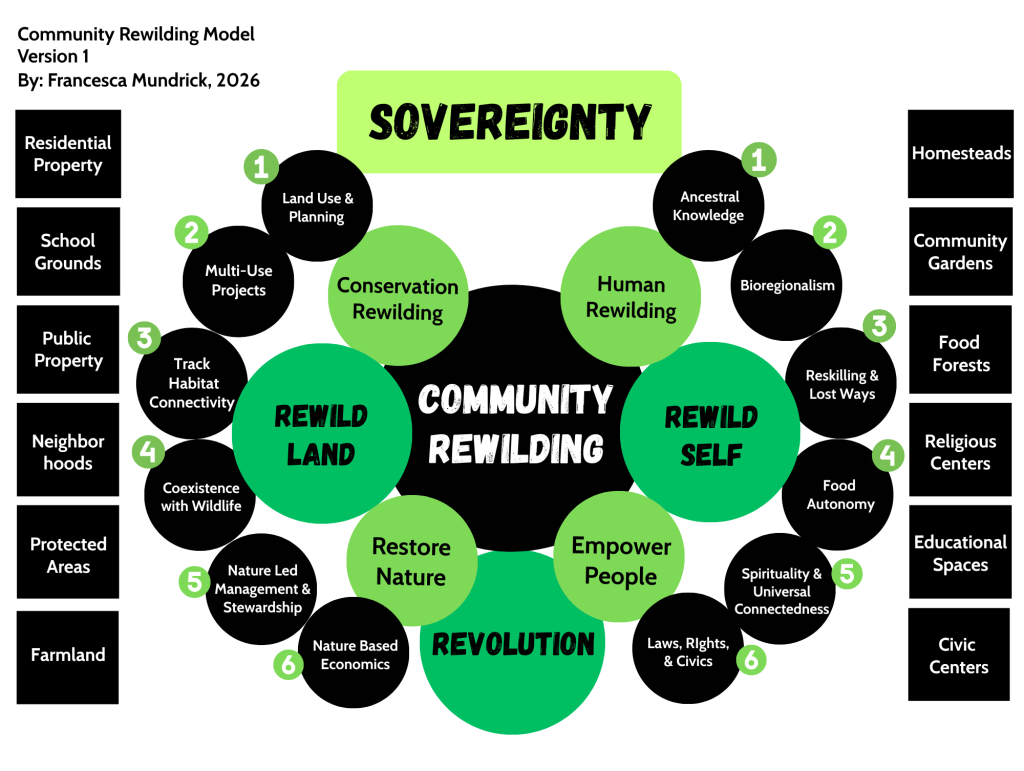
Community Rewilding is an approach that re-establishes the connection between local environments and the people who live there. Community Rewilding, combining both Conservation Rewilding and Human Rewilding in practice, shifts power back to local people who steward local environments and maximize local resources with the application of scalable rewilding efforts in community centers such as homes, schools, workplaces, churches, parks, community gardens, civic centers, and more. Restoring nature and empowering people, this approach counterbalances the modern challenges that we face. Community Rewilding is a form of resistance that works to reform modern systems and shape the future by helping people to achieve sovereignty.
How do we practice Community Rewilding? We Rewild Land and Rewild Self.
In the face of a world in great change, ever “progressing” with advancements promising more, we seek the simplicity and the honesty of the natural world once again. While we may believe the globalist, technological future is imminent, with elitest power infinite, nothing will ever possess more power than our ancient Earth and that power is bringing us home. The reality is people are finding truth in nature once again and that reality will ultimately reign supreme.
To learn more about Fran, visit About the Founder.
Check out this story & more on the Founder’s Blog! Get notified for every new post. Subscribe Today!
We are Preserving the Wild Spirit of New Jersey. Get notified of every new post. Subscribe Today!
Help to Rewild NJ. Join our Community today.
Learn More & Connect
Email: rewildnjcc@gmail.com
Follow us on social media @rewildnjcc.
Donate
Rewild New Jersey Community Cooperative (RNJCC) is completely volunteer based and self-funded. Contribute to support our launch, development, and overhead costs!
 Rewild New Jersey Community Cooperative (RNJCC)
One response to “The Rewild Declaration”
Though provoking. Looking forward to a group discussion.
LikeLike