Why New Jersey?
Why New Jersey?
You might be thinking, New Jersey is the last place on Earth I would think of for practicing new age ideas in community rewilding. This is exactly why New Jersey is the perfect place for community rewilding.
New Jersey gets a bad rap. There are those that say New Jersey is an ugly place. New Jersey is too crowded. New Jersey is nothing but highways and malls. New Jersey is an industrial garbage dump with nothing to offer. New Jersey is just land in between NYC and Philly. As citizens of New Jersey, we know that these statements are false.
It is clear that New Jersey is more than its poor stereotypes. Highly developed, highly populated, and highly impacted by modern factors, New Jersey faces some of the most complex environmental and human challenges in the world. Instead of focusing on the negative, the positive allows us to see that New Jersey’s challenges make for the perfect stage for experimenting with new strategies, ideas, and solutions. New Jersey is an arena for understanding real-world nuances of human-environment relationships. With vibrant natural and human history, cultural diversity and diffusion, and variety of valuable ecological communities, New Jersey should be regarded as an important arena for understanding balances between human prosperity and environmental safeguarding. It is arguable that New Jersey is a mirror in which we can see the national and global future.
New Jersey is the perfect place for community rewilding because its land and people are most at risk for losing the spirit that makes it wild. New Jersey is a special place for people and nature and should not be treated as anything less. It is time that we revamp our view of the Garden State and redefine how the world looks at New Jersey. The more people believe that something is special, the more motivated they are to treat it like it is. Community by community the citizens of New Jersey will create the example of successful statewide community rewilding for the nation and for the world. Learn more about New Jersey here.
Introduction
You might be thinking, New Jersey is the last place on Earth I would think of for practicing new age ideas in community rewilding. This is exactly why New Jersey is the perfect place for community rewilding.
New Jersey gets a bad rap. There are those that say New Jersey is an ugly place. New Jersey is too crowded. New Jersey is nothing but highways and malls. New Jersey is an industrial garbage dump with nothing to offer. New Jersey is just land in between NYC and Philly. As citizens of New Jersey, we know that these statements are false.
It is clear that New Jersey is more than its poor stereotypes. Highly developed, highly populated, and highly impacted by modern factors, New Jersey faces some of the most complex environmental and human challenges in the world. Instead of focusing on the negative, the positive allows us to see that New Jersey’s challenges make for the perfect stage for experimenting with new strategies, ideas, and solutions. New Jersey is an arena for understanding real-world nuances of human-environment relationships. With vibrant natural and human history, cultural diversity and diffusion, and variety of valuable ecological communities, New Jersey should be regarded as an important arena for understanding balances between human prosperity and environmental safeguarding. It is arguable that New Jersey is a mirror in which we can see the national and global future.
New Jersey is the perfect place for community rewilding because its land and people are most at risk for losing the spirit that makes it wild. New Jersey is a special place for people and nature and should not be treated as anything less. It is time that we revamp our view of the Garden State and redefine how the world looks at New Jersey. The more people believe that something is special, the more motivated they are to treat it like it is. Community by community the citizens of New Jersey will create the example of successful statewide community rewilding for the nation and for the world.
Natural New Jersey
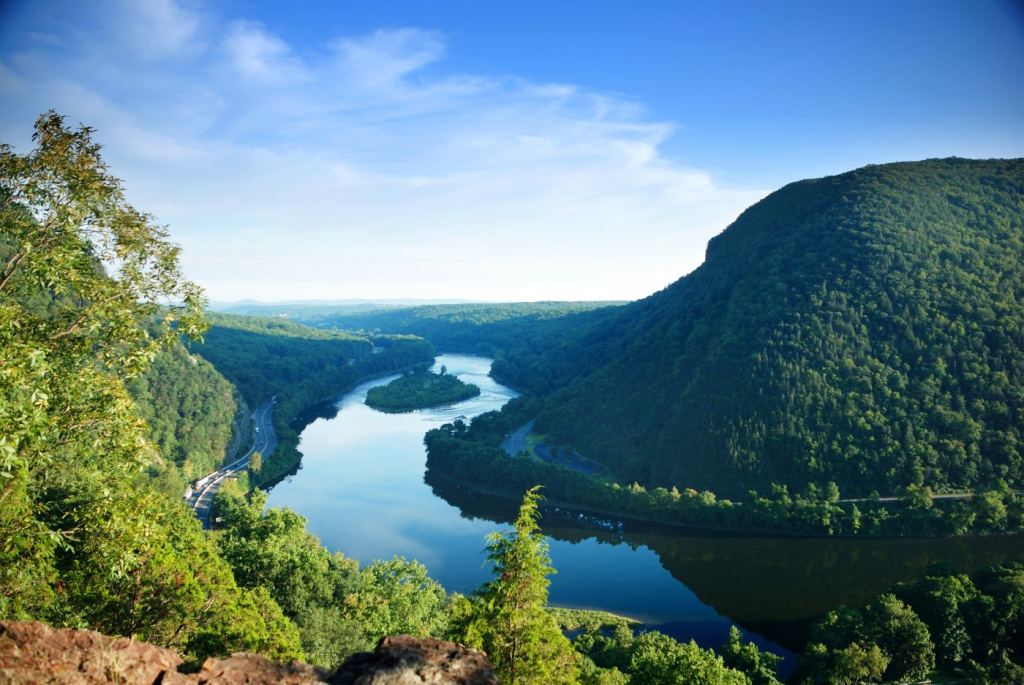
New Jersey’s geology is both startlingly ancient and surprisingly relevant. The northernmost portion of the state, dubbed the Highlands, began to take shape some one billion years ago as the gyrations of early landmasses brought about a mountain-building episode (called an orogeny) which would begin to shape what we today recognize as North America. Parts of our state, it would seem, are five times older than the dawn of the dinosaurs! In a similar vein, a new round of continental collisions beginning around 400 million years ago pushed up much of what we know as the Appalachian Mountain range, including the sliver of northwest New Jersey which geologists refer to as the Ridge & Valley Province.
The same tectonic processes that formed the Appalachians and the nascent North America (then known as Laurentia) would, after many millions of years, begin to rip it apart. A chuck of modern-day North Africa once abutted Staten Island. In an act of great geologic violence – carried out of course at a typically geologic glacial pace – two great landmasses separated and began to drift away from each other. The scars of this geologic trauma can still be seen at places like the Palisades, along the Hudson River.
Although today New Jersey sits thousands of miles from an active volcano, during this period of intense geologic stress some 200 million years ago lava would have flowed frequently from fissures opened by the continental schism. Great swaths of northern and northeastern New Jersey are composed of basalt and other volcanic rock. Stating things more generally, the top half of New Jersey, thanks to the particulars of its geologic history, is built of many hard, relatively impervious types of stone. This would prove of great significance not only to geologists, but to the millions of people who would one day populate the Piedmont Province, as well as the Highlands, and Ridge & Valley.
The northern half of New Jersey is then, comparatively speaking, very old. Those ancient rocks, by virtue of the heat and pressure of the volcanism that helped form them, also host a variety of metals that have greatly influenced the fates of people living in the state, most notably iron. New Jersey’s iron mines forged cannon balls that helped defeat the British, and the Confederacy. They provided the raw material which would be shaped into the Brooklyn Bridge. They also helped New Jersey take center stage during one of the most transformational events in American (and world) history, the Industrial Revolution.
It was another characteristic of North Jersey’s rocky roots though that may have played an even larger role in both the state’s prominence during industrialization, and in the pattern of settlement that still defines New Jersey’s human geography. The hard rock, difficult for water to penetrate, encouraged surficial flow. Not only did this make the northern part of the state a haven for beautiful rivers and reservoirs, it also – especially along the border between the Piedmont Province and the softer Coastal Plain to the south – spawned rapids, white water, and waterfalls. The Great Falls of the Passaic allowed Paterson, New Jersey to be dubbed The Cradle of the Industrial Revolution and Silk City. Along the southern boundary of the Piedmont, known as the “fall line,” the rushing water powered mills of all sorts which encouraged settlement. Soon towns sprang up around the mills, and many of these turned into cities.
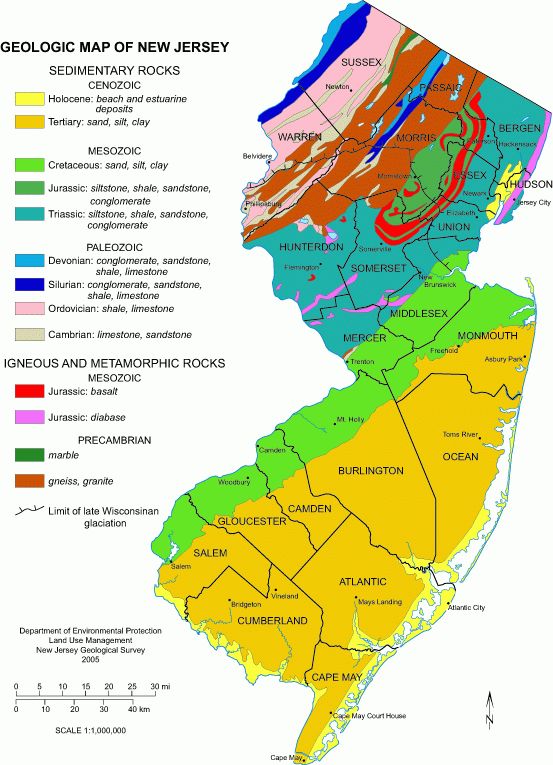
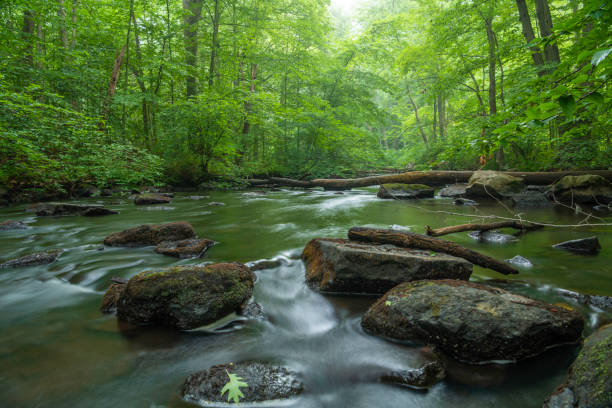
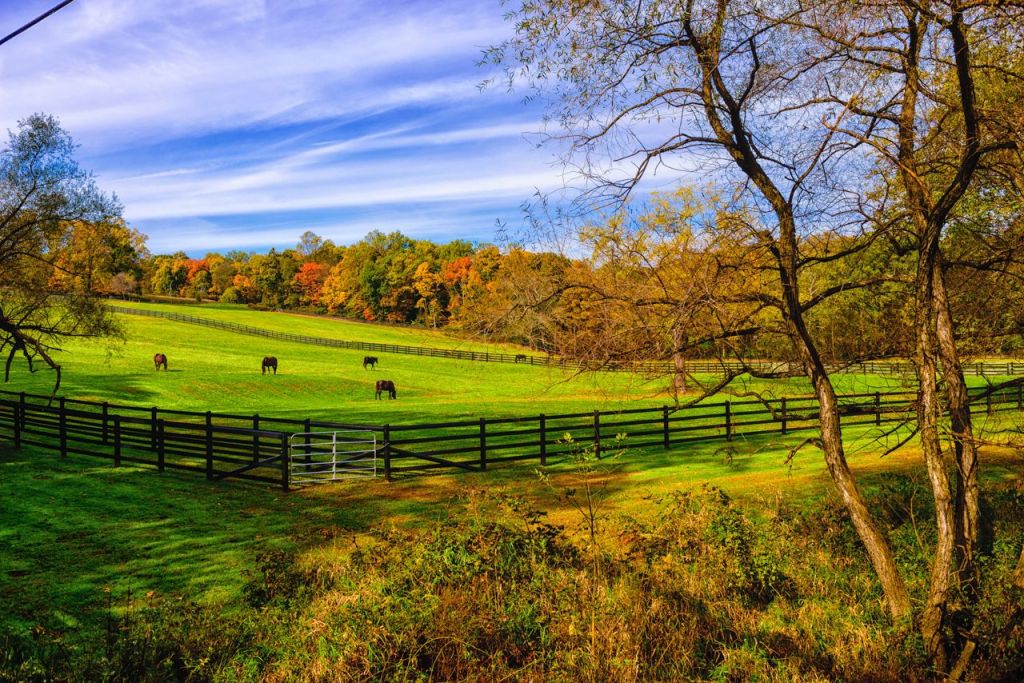
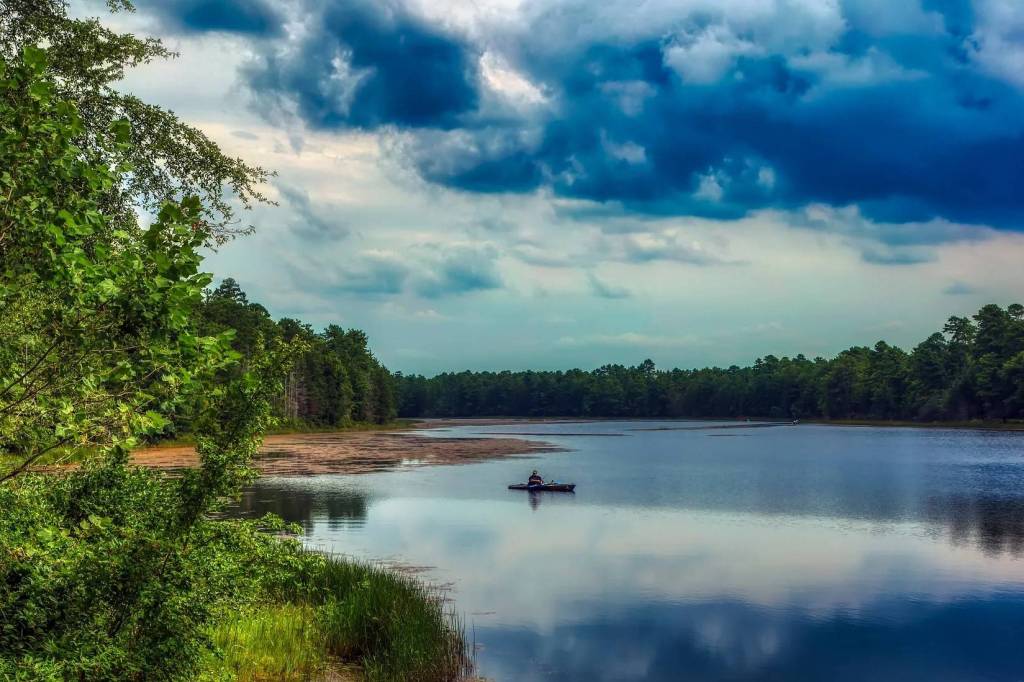
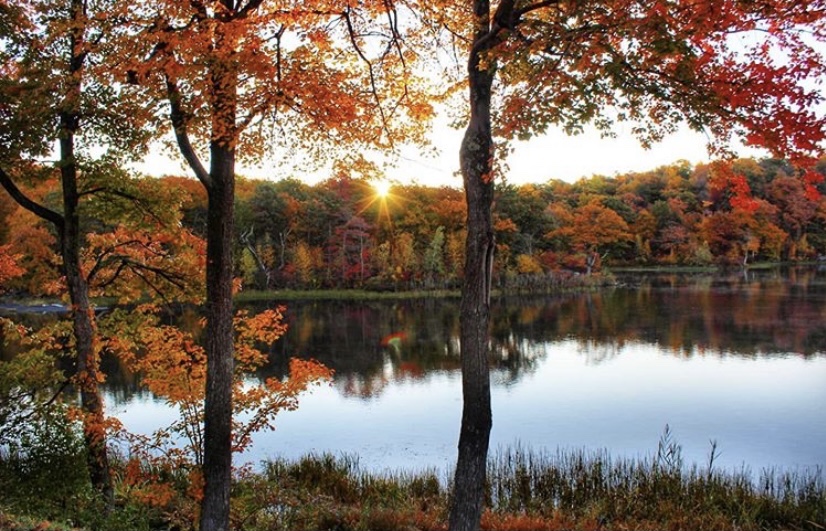
The southern half of the state has a much more recent – and gentle – geologic history. Both the Inner and Outer Coastal Plain Provinces were laid down as sand, silt and clay over thousands (and in some cases millions) of years, the result of a process known as deposition which drew from two general sources. South Jersey, much lower in elevation than the northern portion of the state, has often, since the time of the dinosaurs, been covered by the sea. If you live in South Jersey you are, in some respects, living on the ocean bottom, a fact that explains both the ease with which pieces of seashell can be found in our soil, and the presence of Mosasaur skeletons – an ancient and fearsome sea predator – in our quarries.
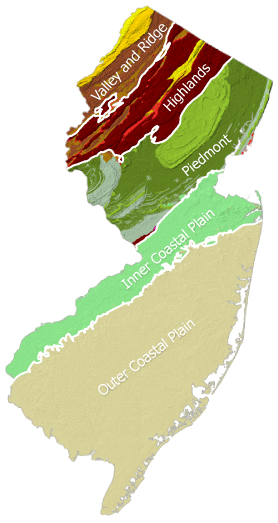
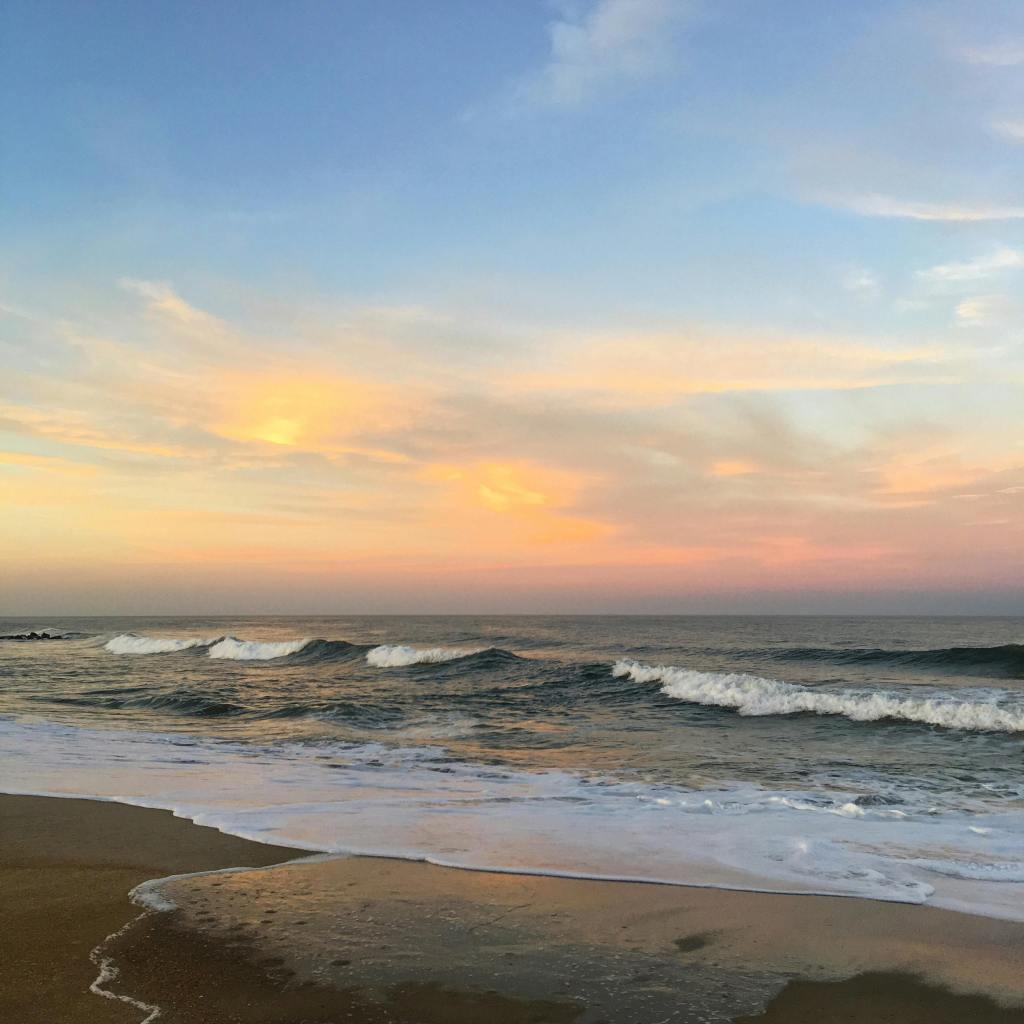
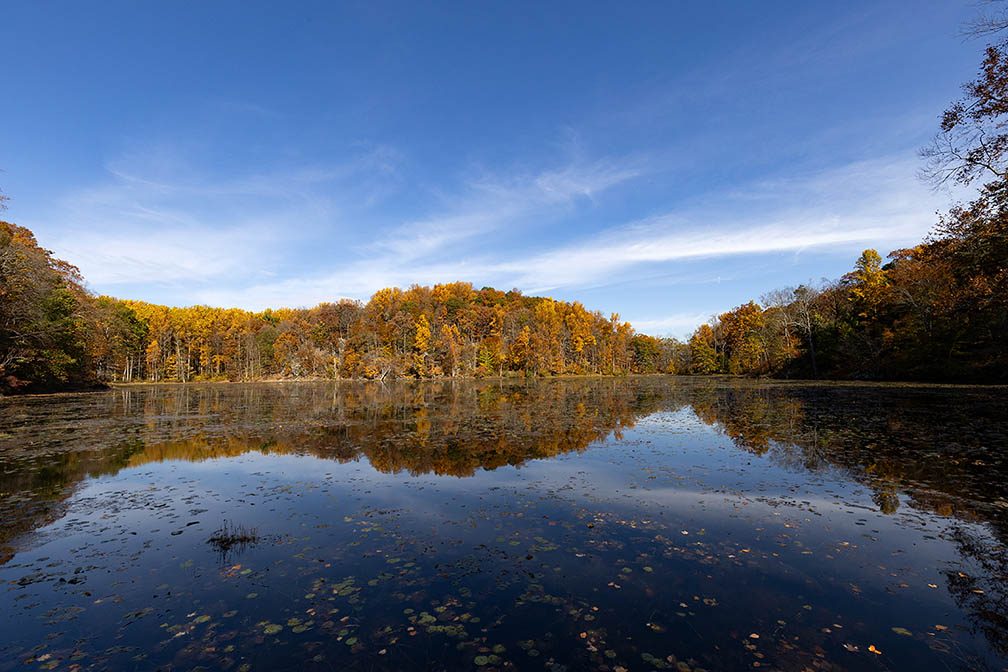
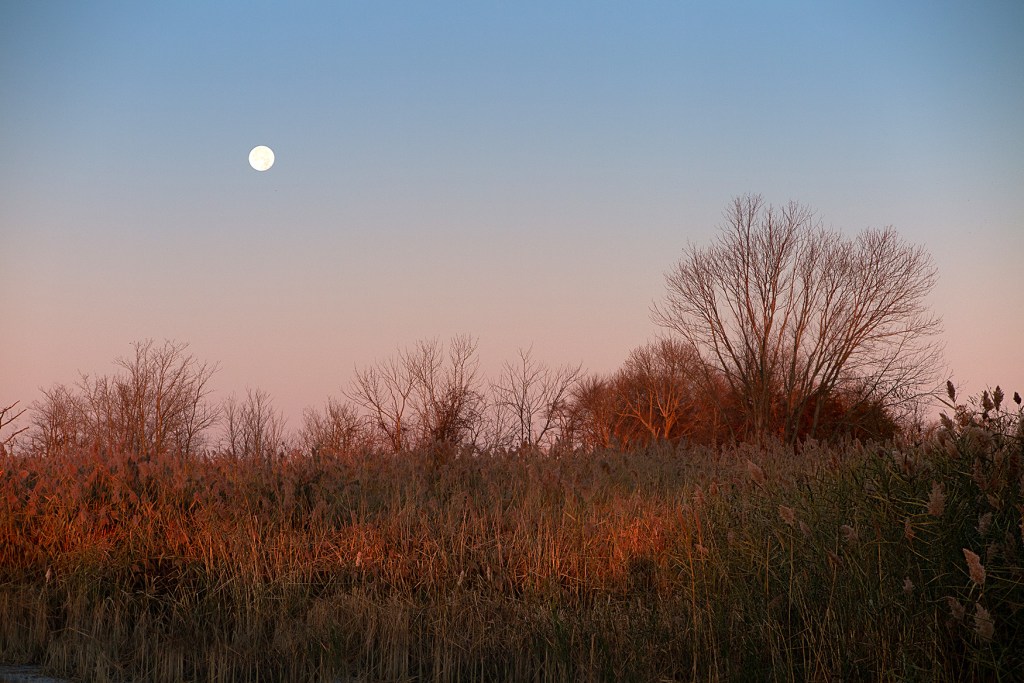
Another source of deposition for South Jersey’s Coastal Plain has been the work of rivers and streams, running south or east from higher ground and dumping rock, dirt and more upon and along the nearly flat river channels working their way toward the Atlantic. Together, these processes, and the geology they fostered, have given South Jersey its distinct and unique character. The clay-rich soils of the Inner Coastal Plain made those lands into some of the best farmland east of the Mississippi, and turned New Jersey, already known as the Garden Colony, into the breadbasket of the American colonies. The Garden State continues to be a leading supplier of produce like tomatoes and peaches. The clay was also the perfect raw material for pottery and brick-making, industries that boomed in Central Jersey both during and after the Industrial Revolution.
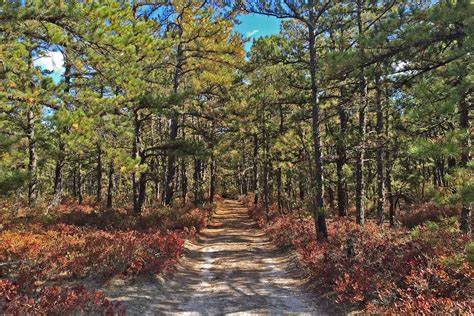
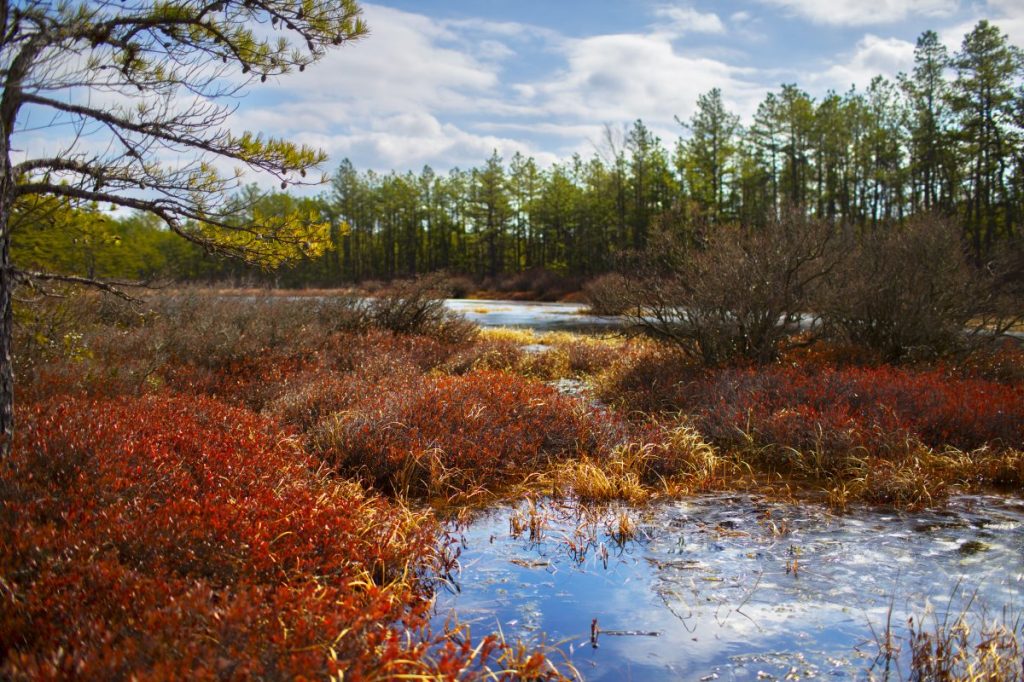
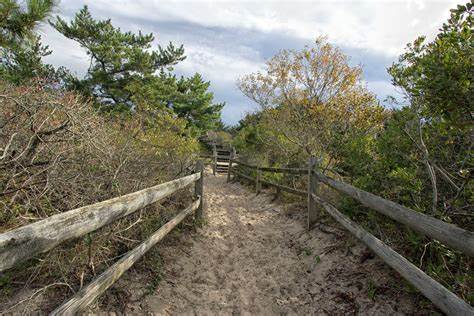
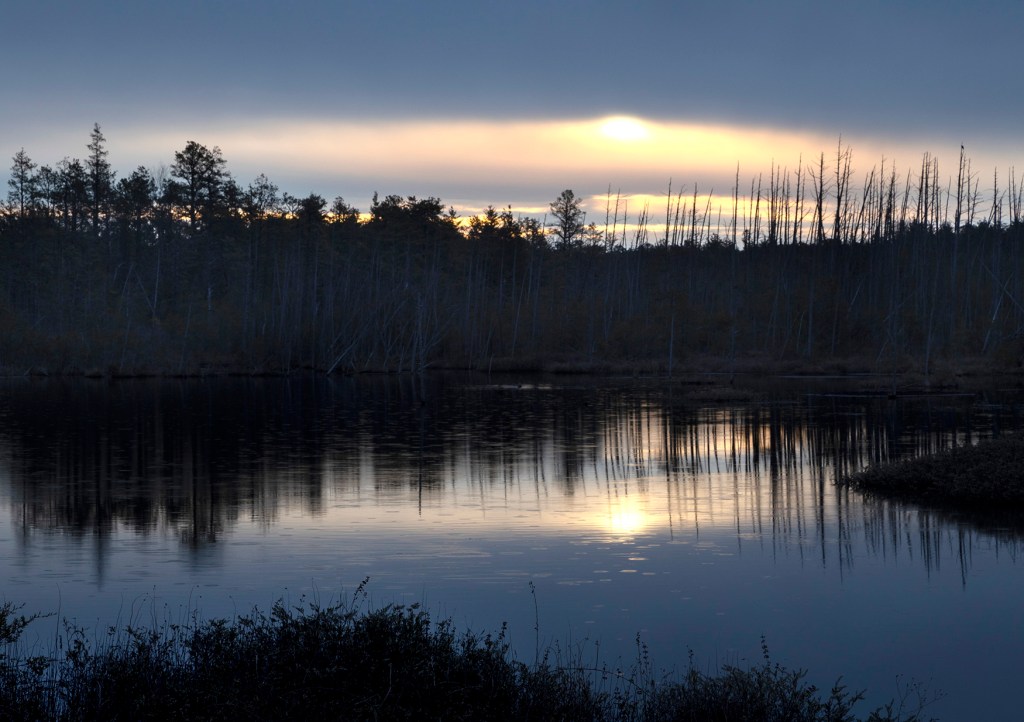
Closer to the shore, much of the Outer Coastal Plain boasted sandy, acidic soil which gave rise to a very unique assemblage of plants and animals. We refer to this region, stretching over some 1 million acres, as the New Jersey Pine Barrens. Less popular with early settlers because of the difficulties in growing staple crops in the sandy soil, the Pine Barrens remained lightly settled into modern times. This provided an opportunity, during the environmentally minded days of the 1970s, to put legislation in place that continues to protect the ecological integrity and beautifully unique and pristine nature of this New Jersey treasure.
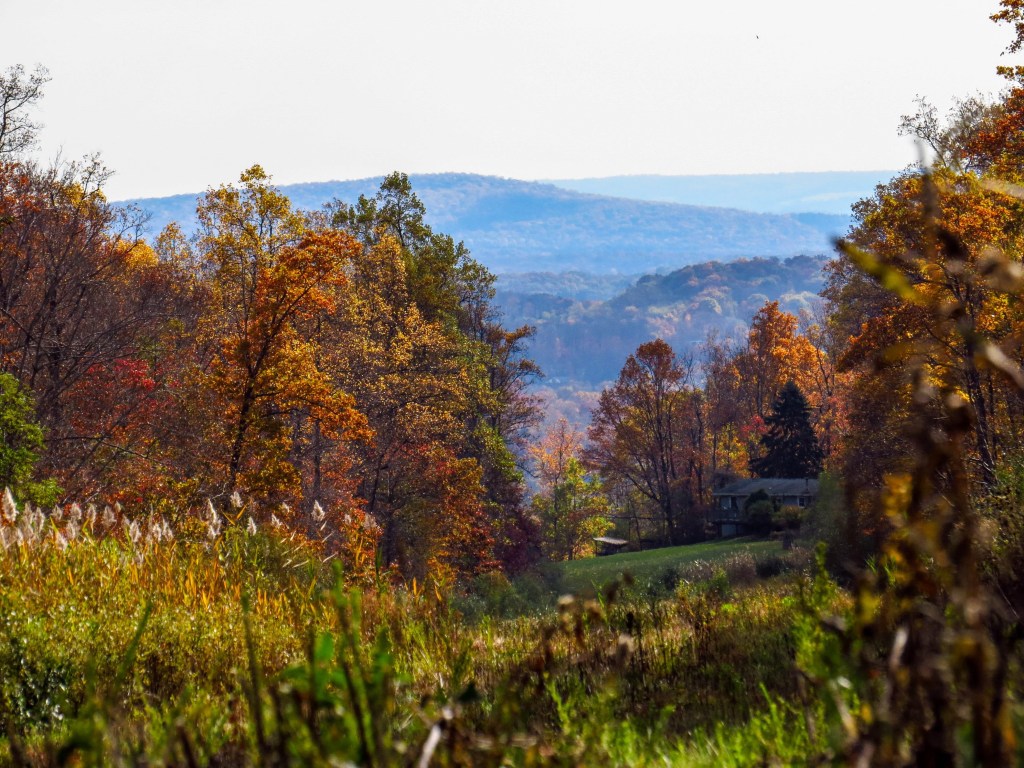
Understanding New Jersey’s signature ecology begins with a recognition of these geologic provinces, and the conditions – soil, rock, water, nutrients – that they, in various forms and quantities, have provided the state’s flora and fauna. The lush, forested hillsides of the Highlands and Ridge & Valley regions are fed by fast-moving streams, the pristine nature of which is largely ensured by the trees themselves. Because penetrating the hard rock to reach the groundwater below is difficult, North Jersey is well suited to reservoirs, lakes and rivers. These water bodies, along with the vegetation they foster, provide ideal habitat for a wide range of creatures characteristic of a temperate forest. From black bears to beavers to bald eagles, the hills of North Jersey are home to an incredible diversity of life.
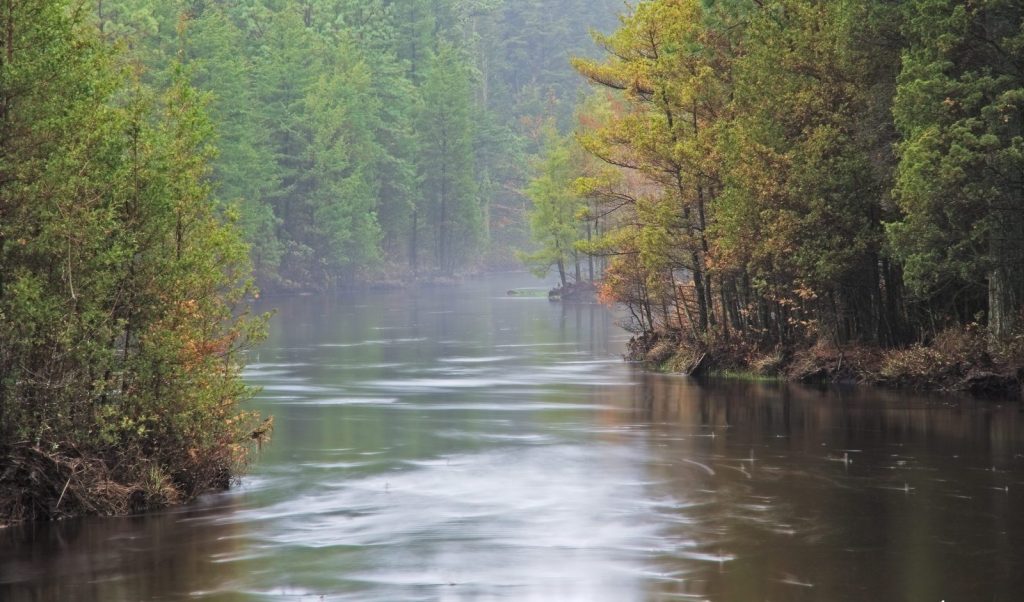
In South Jersey, the sandy, acidic soil characteristic of the Outer Coastal Plain has given rise to its own, truly unique assemblage of plants and animals. The evergreens which lend the Pine Barrens its name are able to thrive in the relatively dry, nutrient-poor soils that many deciduous trees struggle to survive in. The fires that periodically sweep through the area also favor the pines, as the germination of their cones is triggered by the heat. The region’s characteristic cedar bogs and tannin-stained waters provide habitat for many species rarely seen elsewhere, like the Pine Barrens Treefrog and the Swamp Pink. The sandy, acidic soils, though not suitable for many types of farming, are perfect for the cultivation of cranberries and blueberries, two of the areas historical and signature industries!
Far from simply an arcane exercise in academic place-naming, the geologic provinces and geologic history of New Jersey tell a fascinating tale of our state’s formation, and, significantly, directly inform our understanding of how people have lived, where they have lived, and why New Jersey enjoys and displays the unique character that it does today.
Human New Jersey
New Jersey is at the very center of an industrial, technological, and globalized past, present, and future. Archeologists estimate that New Jersey was first populated by Paleolithic humans some 12,000 years ago. Over the generations, indigenous New Jerseyans eventually came to be known as the Lenni-Lenape of Lenapehoking. They called the area Scheyechbi, or “land along the water.” These original inhabitants carried out many of the same basic activities and crafts that, unbeknownst to them, other humans were endeavoring to do an ocean away – farming, route-finding, harvesting the sea. When Europeans first visited these shores, they were surprised by (and, in many cases, oblivious to) the fact that these “natives” were experts at cultivating the land (the use of fire is an excellent example), and lived in highly organized societies.
The “Age of Discovery” brought Europeans to American shores, including those of New Jersey. The first European to explore the coastline of what would become New Jersey was likely Giovanni de Verrazano, who anchored off Sandy Hook in 1524. New Jersey was settled by the Dutch, Swedish, and Finnish people in the 1610s, soon after Henry Hudson, sailing under a Dutch flag, entered Newark Bay in 1609. In 1664 an event of lasting significance occurred when the future New Jersey, along with a small island called Manhattan, was transferred from the Dutch to English control. So began a bumpy, contentious century as an English colony (and, for a time, two colonies – East and West Jersey).
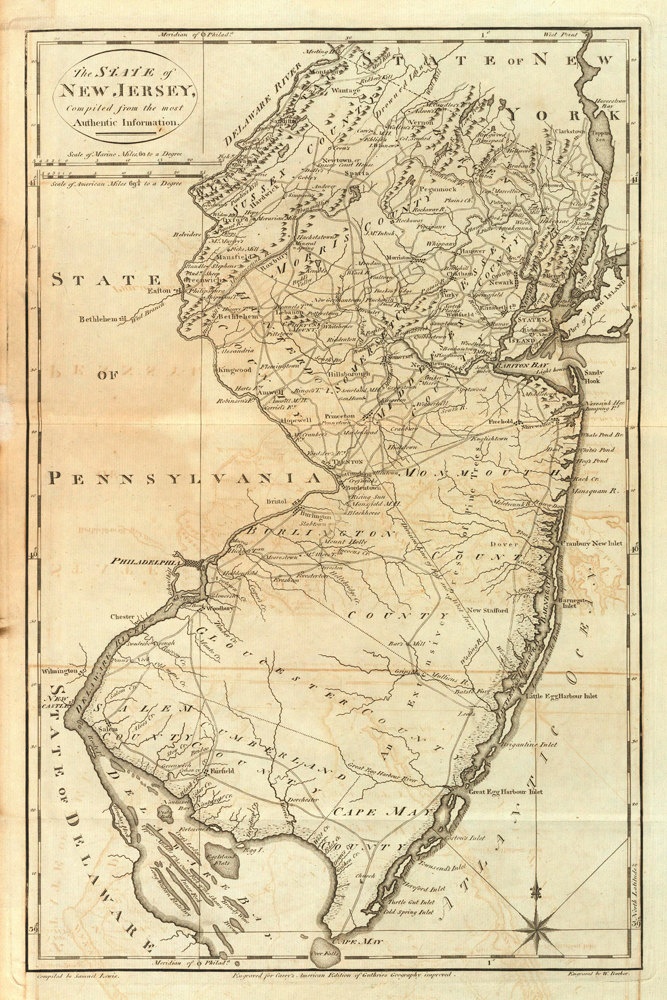
The colony, named New Jersey by the Duke of York soon after the English gained control to recognize the service of East Jersey Proprietor George Carteret, would play a central role in the fierce battle for independence we know as the American Revolution. General George Washington spent much of the war crisscrossing New Jersey, and at least two seminal battles, those at Trenton and at Princeton, were fought on New Jersey soil. The colony and soon-to-be state is rightly known as “The Crossroads of the Revolution.” The Battle of Springfield, fought on June 23, 1780, was the last engagement with the British in New Jersey, and indeed the last time Americans encountered a foreign adversary on New Jersey soil.
New Jersey became a foundational part of the booming industry, immigration, and urbanization that marked the American Industrial Revolution, serving as a land of promise and a source of raw materials for the expanding metropolitan areas of New York City and Philadelphia. The state’s ample natural resources played a critical role in establishing our country as the world’s burgeoning industrial leader. Thanks to the power provided by the Great Falls of the Passaic, Paterson became the nation’s first truly industrialized city. North Jersey’s iron mines helped build skyscrapers and combat the British, the Confederacy, and eventually the Germans!
Our state’s proximity to Ellis Island positioned New Jersey at the heart of the immigration explosion that marked the late 19th and early 20th centuries. European immigrants by the millions – many from Ireland and Italy – streamed through Ellis Island and jammed the railway cars in Jersey City, eager to establish new homes and new lives in this “land of opportunity.” Their stories mixed with those of established Jersey residents to weave the cultural fabric of our state, a fabric that was made richer and more diverse as New York City continued (and continues) to be a beacon for immigrants from around the world.
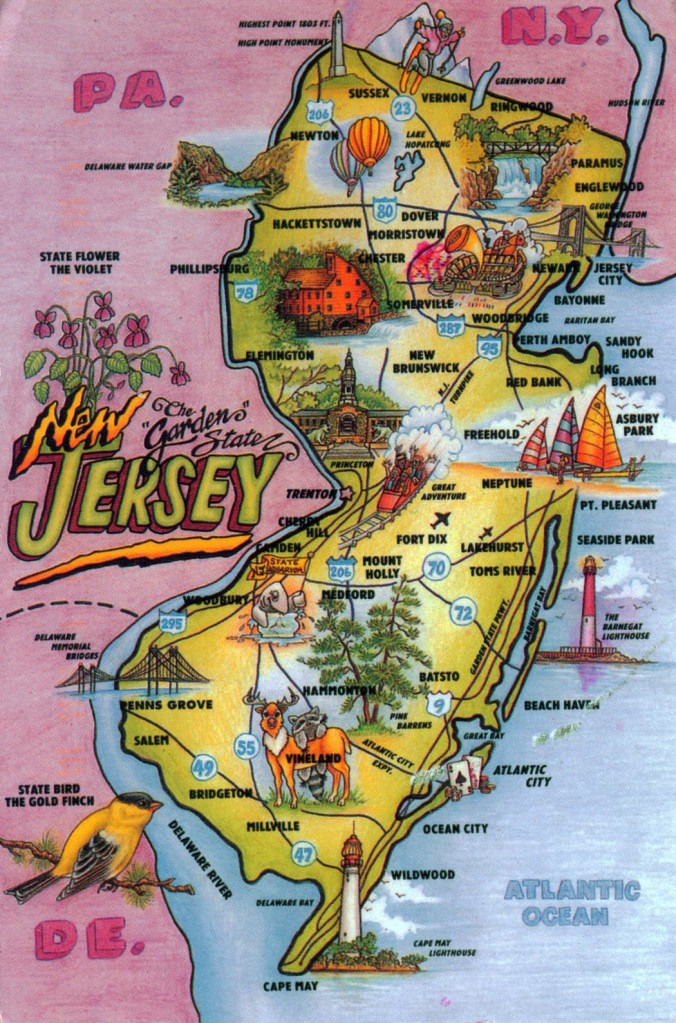
Thus are the beginnings of modern New Jersey to be found in the history of previous centuries. After World War II, decisions by the federal government to fund new infrastructure for transportation, mass interstate and regional highways, and roadways for cars led to massive land use changes, setting the standard for modern planning and land use trends in our state. The practices that developed fostered metropolitan areas, suburbia, and urban/suburban sprawl. New Jersey became a poster child for suburbia – increasingly developed due to the housing demand from growing urban centers. Yet, through far-sighted planning and the work of its citizens, New Jersey has been able to retain much of its agricultural and ecological character, even in the face of these ever-growing development pressures.
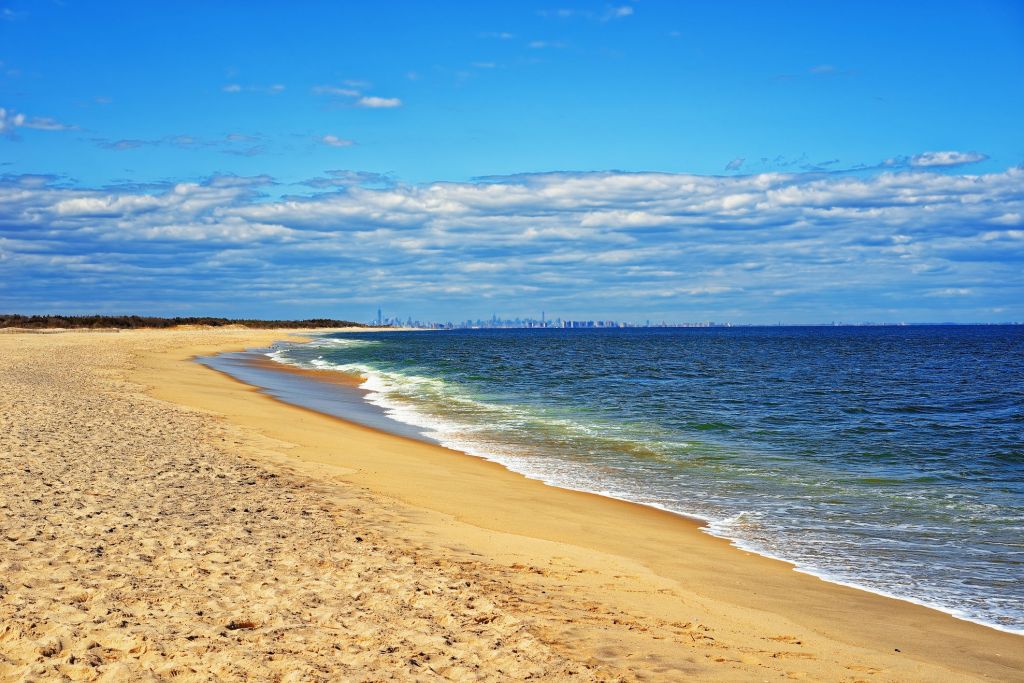
The incredible variety and diversity of land uses, ecosystems, and types of human habitation within a state of very limited areal extent makes New Jersey a modern wonder, and the perfect canvas on which to paint a startling new image of what environmentalism and rewilding can look like. New Jersey is not simply a traffic-clogged, smokestack-lined stretch of turnpike. We are also sandy dunes bearing tracks of plovers and terns. We are quiet, gently flowing iron-stained cedar bogs. We are lush, rich farmlands thrilling children on tractor rides and in pumpkin patches. And we are steep, deeply forested hillsides with fertile valleys providing cover for the Eastern U.S.’s densest population of black bears.
New Jersey is also a portrait of the people who have settled here over many centuries and made the state their own. It is a testament to the many revolutions, innovations and institutions that together have shaped our nation. New Jersey bears the scars of industrialization, and its cities are the manifestation of two hundred years of growth, tumult, opportunity and stark realization. Its forests and waterways reveal another aspect of the state’s character, and demonstrate a connection to older ways of connecting with the land – older values. New Jersey’s people have been drawn in waves from virtually every corner of the world. We are indeed a melting pot, a pot stirred by a vision of what America could have been, and indeed still could be.
Taken together, the state’s rich history provides the historical, economic and cultural backdrop that defines our daily lives in New Jersey and has crafted our relationship with our local communities and environments. We drive our cars on highways that follow centuries-old “Indian trails,” live in houses built during the post-war boom of suburbia, and attend cultural events that trace back to 19th century immigrants, or before. New Jersey’s human geography is one of triumph and tribulation as our ever-changing landscape has supported the development of the modern world. Now, as in the past, we fight to realize a vision for the future of our state; a vision that connects us to the land, and to our own roots, as well as to the frenetic push for progress that characterizes our nation.
Rewilding New Jersey
Looking at a nighttime satellite image of the Eastern seaboard the bright lights of our modern metropolises, contrasting starkly with the darkness of the Atlantic Ocean, catch and hold your attention. This stretch of densely populated coastal plain, particularly the section running north from Washington D.C. and Baltimore to Boston, has been and remains as much at the heart of human endeavors on Planet Earth as any stretch of similar geographic extent that you can find. When you look closer however, and with a slightly different eye, you realize that sitting at the very center of this singular stretch of cities is New Jersey. It is a position that our state, in many different ways and without a great deal of fanfare, has occupied since the days of the American Revolution. It is a great place to begin a new revolution – a rewilding revolution.
Geographers study both physical phenomena – the mountains, valleys, rivers, lakes, and plains associated with a specific part of our planet – as well as the human occupation of and utilization of that physical area. We hope that the readings provided here on New Jersey’s geologic and human past and present have convinced you that our small state has a singularly unique story to tell. A story that combines both the people and the land they’ve settled and transformed.
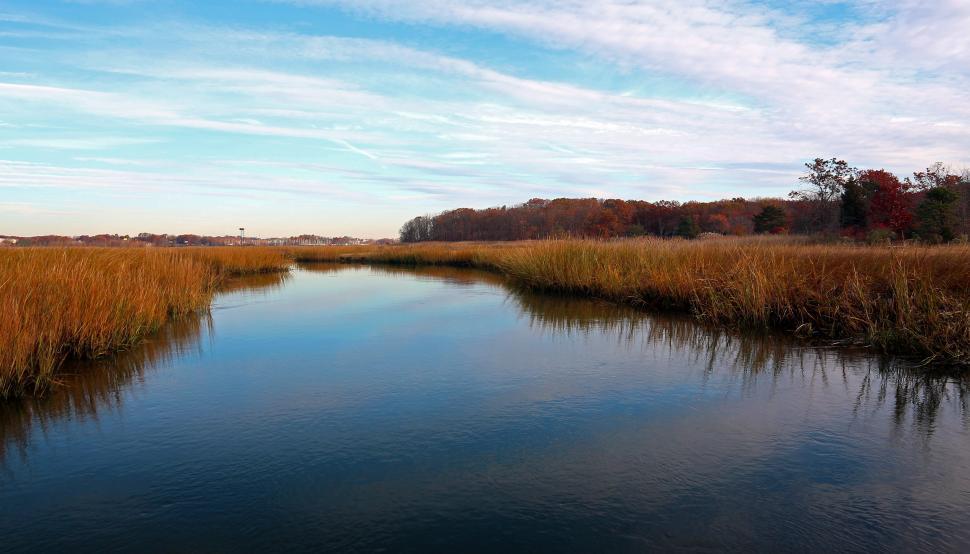
Very few states – or regions – have as much to treasure, to protect, or to lose. We have innately grasped this in New Jersey and acted upon that impulse. In 1969 New Jersey established the Hackensack Meadowlands Commission, one of the nation’s first environmental agencies at the state level. A decade later the state legislature passed the New Jersey Pinelands Protection Act, a seminal piece of environmental legislation that continues, nearly 50 years later, to shield the one million acres of pine forest, cedar swamp, sand trail and cranberry bog from wonton development. In 2004 the state enacted the New Jersey Highlands Water Protection and Planning Act, seeking to ensure clean, safe drinking water for our citizens and maintain the unique ecological character of the New Jersey Highlands.
Now, many see an opportunity for New Jersey to stand at the forefront of a new type of environmental protection, and perception. One in which those who call New Jersey home recognize, reestablish and enhance the connection between people and nature that ultimately defines our lives and the communities we’ve built.
New Jersey has pioneered new ways of living before. The attractiveness of our natural environment lured workers from New York City (and later, Philadelphia) across rivers to new, stately homes in the “suburbs.” As those metropolitan areas grew, so did the perception of New Jersey as the perfect combination of “wild and civilized.” Meanwhile, New Jersey was inventing the concept of a shore town, and indeed the very idea of vacationing by the sea. When President Ulysses S. Grant chose Long Branch, NJ, as his “summer capital” beginning in 1869, he unwittingly set in motion a momentum that would, by the end of the 19th century, see Atlantic City become the crown jewel of the Eastern seaboard. Our devotion to this particular aspect of the state’s geography has clearly only deepened since.
So much to treasure, and so much to potentially lose. The time to connect with our environmental heritage, with our state’s rich history, and with the identity the land provides is now. Whether that identity draws from the state’s beaches, the tranquil forests of the Pinelands, our industrious farmland, the scenic hills of the Highlands, or the cultural wealth of our towns and cities – now is the time to recognize, appreciate and deepen the connection. Now is the time to rewild New Jersey.
By: Richard Federman & Francesca Mundrick, 2025
We are Bringing Rewilding to New Jersey. Get notified of every new post. Subscribe Today!
Help to Rewild NJ. Join the Rewild NJ Movement today.
Learn More & Connect
Email: rewildnjcc@gmail.com
Follow us on social media @rewildnjcc.
Donate
Rewild New Jersey Community Cooperative (RNJCC) is completely volunteer based and self-funded. Please contribute funds to support our launch, development, and overhead costs!
 Rewild New Jersey Community Cooperative (RNJCC)