By: Sam Scalio, Outreach & Engagement Intern
I recently had the opportunity to visit Chile to conduct anthropological work with a team of students under the purview of Dr. Maria Rosado of the College of Humanities & Social Sciences at Rowan University. As a Rewild NJ Intern, many connections and ideas came to mind over my trip!
Chile provides a microcosm of global cultural dynamics as well as being a place where traditional ways of life, colonial history, and modern social changes intersect in
various ways, offering some of the richest material for anthropological study. Our group specifically focused on the indigenous communities such as the Mapuche and Diaguita, which were excavated by Dr. Rosado in the early 2000s in the Guanaqueros region. During our time there, our work involved examining skeletal remains to ascertain their age and biological sex.
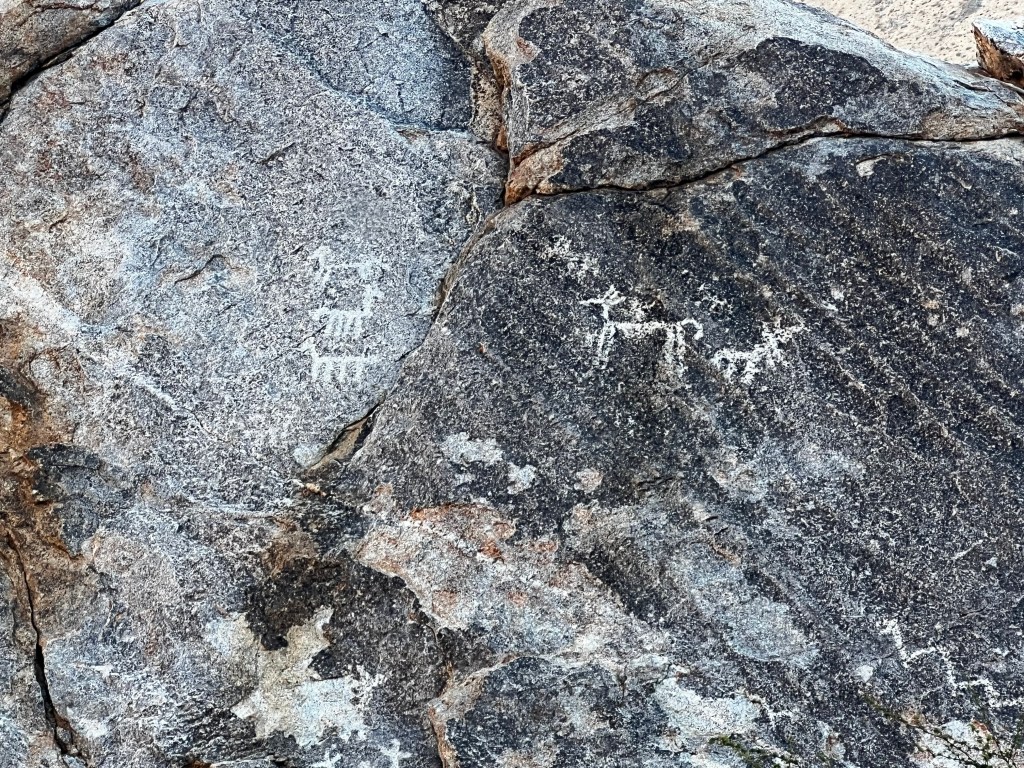
With this, we could apply osteological techniques to help us get a better understanding of these historic populations and to get a glimpse into what life may have been like for these cultures a thousand years ago.
Our team’s hands-on analysis provided insight into the lifestyles, social structures, and health of the communities tied to both the Mapuche and Diaguita, while also being able to highlight the meticulous methods required in anthropological research. This
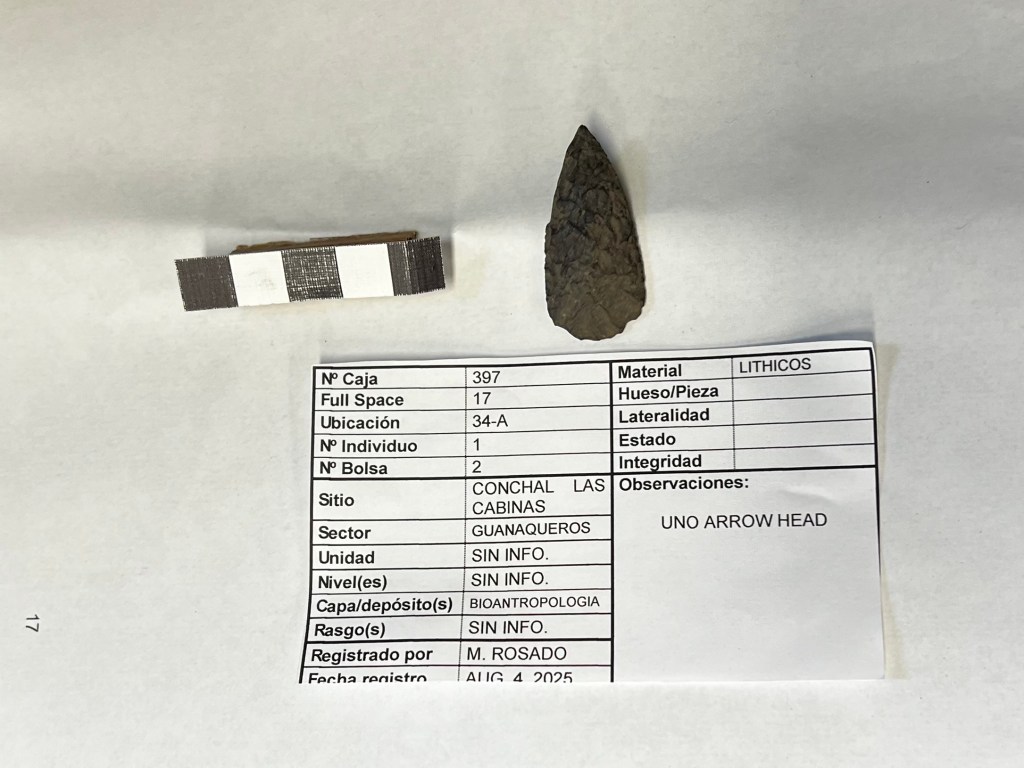
allowed us to be able to engage directly with the physical evidence of these past lives, which allowed us to connect historical findings with broader questions that reside in identity, cultural continuity, and the many ways in which humans adapt over time. One of my personal favorite experiences during our work was coming across the finding of a 3,000-year-old arrowhead (pictured below).
Now we cannot be 100% sure what this arrowhead was directly used for, as in whether it was meant to be used for big game, humans, or smaller game, but we can use context clues. What we came across was an arrowhead that still had a sharp point, even after 3,000 years! We believe this specific arrowhead was used for hunting various species of birds, given that it was very small compared to older, bigger arrowheads we came across, which were used for bigger animals, and at times humans in times of conflict.
My experience during this trip was enchanting. As I am writing this, I am sitting in a Hostal waiting to be picked up to unfortunately leave. Being able to study and analyze the Mapuche and Diaguita, then head to La Serena, Isla Damas, Coquimbo, Elqui Valley, and, of course, Santiago, really allows you to see the cultural richness and diversity of not only the population but the geography of Chile as well in a way that reading or seeing it online could ever capture. From the quiet coastal villages where fishing and artisan traditions shape the daily life of those who live here, to the mystical landscapes of the Elqui Valley with its pisco distilleries (pisco/mango sour) and starlit observatories. These starlit observatories were breathtaking.

Using a telescope, we went to look in depth at not only the Milky Way but also Alpha Centauri I and Alpha Centauri II, and got the chance to see many dying stars thousands of light-years away from Earth. This trip overall changed my perspectives on many aspects of life, but it truly deepened my appreciation for the complexities of culture, the resilience of communities, but also the importance of anthropological studies in connecting the past with the present.
Check out this story & more on the Community Blog! Get notified for every new post. Subscribe Today!
We are Bringing Rewilding to New Jersey. Get notified of every new post. Subscribe Today!
Help to Rewild NJ. Join the Rewild NJ Movement today.
Learn More & Connect
Email: rewildnjcc@gmail.com
Follow us on social media @rewildnjcc.
Donate
Rewild New Jersey Community Cooperative (RNJCC) is completely volunteer based and self-funded. Please contribute funds to support our launch, development, and overhead costs!
 Rewild New Jersey Community Cooperative (RNJCC)