By: Sam Scalio, Outreach & Engagement Intern
I grew up in South Philly, where green space can be hard to find, and having a tree on your block or two made it stand out amongst other streets. My neighborhood, as well as most of South Philly, consists of row homes, sometimes expansive, then narrow sidewalks, chain link fences, and corner stores.
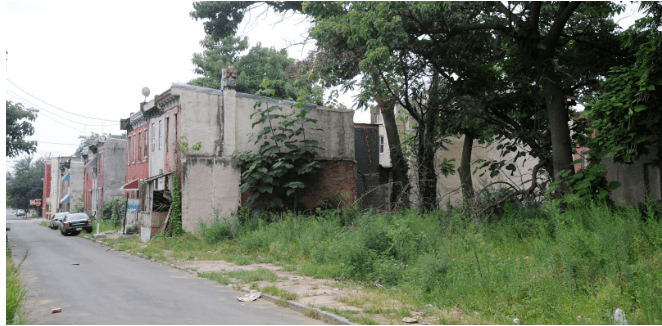
Despite the seemingly endless rows of houses and large winding sidewalks, nature persisted through the concrete. Nature reclaimed itself by taking back alleyways that cats call home and use the vines and ladders, and shade to go from home to home, being fed. Nature can also make a home in the places we forget and neglect. Growing up, we would see a lot after a lot that would be vacant lots being overrun by wildflowers, tall grasses, and, unfortunately, trash. Being a kid in South Philly, these were the areas where we enjoyed playing basketball, street hockey, and just enjoyed our time together, but while thinking to ourselves that this was mostly a useless area, hence why we could use it. In reality, it was a small bubble of rewilding just waiting to be able to burst, and within that small bubble of nature in South Philly, it still acts as a core memory for friendships and community events, speaking to the connections that are made socially and environmentally when just a little bit of nature is reclaimed.
All of us are connected to the land in which we live. Walking down South Philly, we would know which streets had better shade to walk, which ones had trees, and could tell the season based on the food trucks stopping at various corner stores. This helped me develop a deep connection with the land I lived on without even realizing it, and it was a part of my daily life.
This is the core of bioregionalism, living in connection with the natural characteristics of what makes up your daily life and the place you are in. It is also about recognizing and reflecting on places that can be as densely built and populated as Philly can still be part of a nurturing and thriving ecological system. We as people are shaped by our place, climate, watersheds, and soil, even if we do not directly see or feel them. Rewilding in this sense of bioregionalism is not about turning a city into a forest dystopia; it is about growing and working with the land instead of constraining and ignoring it. Vacant lots are prime real estate for pollinator gardens, community gardens, places of commerce, and community. It involves teaching children the names of local plants and assisting neighbors in realizing that a flourishing city is about ecology, culture, and community rather than just infrastructure and economy.
Despite being encircled by asphalt, South Philly is a bioregion built on tidal marshlands, giving us all our beautiful native plants. The more we understand that, the more we can rebuild not only the land but also our connection to it.
Check out this story & more on the Community Blog! Get notified for every new post. Subscribe Today!
We are Bringing Rewilding to New Jersey. Get notified of every new post. Subscribe Today!
Help to Rewild NJ. Join the Rewild NJ Movement today.
Learn More & Connect
Email: rewildnjcc@gmail.com
Follow us on social media @rewildnjcc.
Donate
Rewild New Jersey Community Cooperative (RNJCC) is completely volunteer based and self-funded. Please contribute funds to support our launch, development, and overhead costs!
 Rewild New Jersey Community Cooperative (RNJCC)